

 By Sunshine Phillips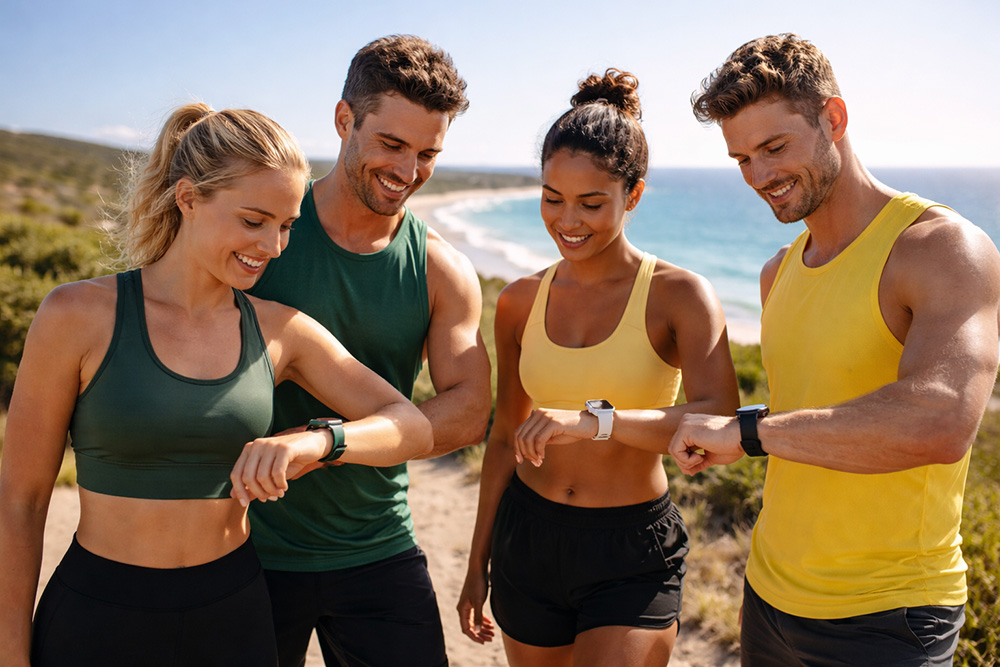
At dawn along the Tan Track in Melbourne, before the city’s cafés hum to life, runners move in quiet rhythm beneath the gum trees. Some glance not at the skyline, but at their wrists. A soft vibration signals pace drift. A coloured ring closes. A heart rate zone stabilises. Running, once governed by breath and instinct alone, is now guided by algorithms. In Australia, a nation shaped by coastline, bushland, and sporting culture, wearable technology is not merely enhancing running—it is reshaping the runner’s identity.
Australia has long embraced endurance sport. From suburban parkruns to the rugged Kokoda Challenge and the global spectacle of the City2Surf, running is woven into community life. Yet over the past decade, the sport has undergone a quiet revolution. Devices from companies like Garmin, Apple, and Fitbit have transformed the wrist into a command centre. The modern runner no longer trains solely by feel; they train by feedback.
At the heart of this shift is data. GPS tracking maps every kilometre along Bondi’s coastal paths or Brisbane’s river loops. Optical heart rate sensors provide real-time cardiovascular insights. Cadence metrics reveal inefficiencies in stride. Sleep tracking assesses recovery quality. What was once anecdotal—“I felt strong today”—is now quantifiable: VO₂ max estimates, lactate threshold projections, heart rate variability trends.
This quantification is not trivial. Exercise physiology tells us that adaptation depends on calibrated stress and sufficient recovery. Too little stimulus yields stagnation; too much invites injury. Wearables help navigate this fine line. By monitoring training load and recovery status, runners can avoid the overtraining syndrome that has sidelined many enthusiastic athletes. In a country where recreational running participation continues to grow, this preventative insight is invaluable.
But technology is doing more than reducing injury risk. It is reshaping motivation. Behavioural science suggests that immediate feedback enhances habit formation. Closing activity rings or achieving weekly kilometre goals activates the brain’s reward circuitry. For many Australians balancing demanding careers and family life, this micro-validation matters. A lunchtime 5km in Perth’s Kings Park becomes not just exercise, but a measurable achievement.
Community, too, has been digitised. Platforms like Strava have transformed solitary runs into social experiences. Segments along Sydney’s coastal cliffs turn into friendly competitions. Virtual badges connect runners in Darwin with peers in Hobart. Data sharing fosters accountability and camaraderie, amplifying Australia’s already strong sporting culture. Running clubs still meet in person, but now conversations include pace analytics and heart rate zones alongside shoe recommendations.
Yet beneath the optimism lies nuance. The smart runner’s lifestyle introduces new psychological dynamics. Data can empower—but it can also constrain. A runner may ignore bodily intuition because their watch prescribes a slower pace. A missed goal may trigger disproportionate disappointment. The challenge becomes integration: using technology as a guide rather than a tyrant.
Interestingly, Australian geography amplifies the value of wearables. The country’s vast landscapes—from alpine trails in Victoria to humid Queensland summers—create variable environmental stressors. Advanced watches now estimate heat acclimation and adjust training load recommendations accordingly. Barometric altimeters assist trail runners navigating elevation changes. For ultramarathoners crossing remote terrain, GPS safety features provide peace of mind, enabling adventure with calculated risk.
Wearable technology also intersects with public health. Australia faces rising rates of lifestyle-related chronic disease. Government initiatives often promote increased physical activity as a preventative strategy. Wearables offer scalable support for this goal. Step counts, inactivity alerts, and guided workouts make movement tangible. When thousands of Australians track their daily activity, health shifts from abstraction to visible metric.
The economic ripple effect is equally notable. Specialty running stores increasingly offer gait analysis supported by sensor data. Sports scientists integrate wearable analytics into personalised coaching. Corporate wellness programs subsidise devices to encourage employee fitness. A lifestyle once defined by simplicity—shoes and road—now includes subscription apps, cloud dashboards, and data-driven insights.
Technologically, the evolution continues. Artificial intelligence is beginning to personalise training plans based on longitudinal data patterns. Machine learning models predict injury risk by analysing subtle deviations in cadence and ground contact time. Integration with smart footwear and biometric sensors promises even deeper insight into biomechanics. For elite Australian athletes preparing for global competitions, marginal gains matter. For recreational runners, personalised feedback enhances safety and satisfaction.
Yet perhaps the most profound transformation is philosophical. Running, historically romanticised as an escape from modernity, now coexists with it. The bush track becomes both sanctuary and data stream. The sunrise over the Gold Coast is still breathtaking—but it is also logged, analysed, and compared.
Does this diminish the purity of the sport? Not necessarily. Humans have always sought tools to extend capability. Just as high-performance shoes revolutionised marathon times, wearable technology extends awareness. The key lies in balance. The smart runner understands that numbers inform but do not define them. A watch may measure heart rate, but it cannot quantify awe.
In Australia’s expansive landscapes, where distances are long and horizons wider still, wearable technology offers a bridge between instinct and intelligence. It allows runners to explore safely, train efficiently, and connect socially. It democratizes performance insights once reserved for elite athletes, placing them on suburban wrists.
Ultimately, the smart runner’s lifestyle is not about surrendering to data—it is about conversing with it. Technology becomes a training partner, whispering guidance while the body delivers effort. In this partnership, Australian runners are crafting a new narrative: one where innovation and endurance coexist, where ancient instincts meet modern algorithms, and where every stride carries both tradition and transformation.